Monday, June 19, 2006

Produce your boyfriend - or else...

The title reminds me of the punchline to a bad joke, but unfortunately this is not a joke.
I was listening to a Ghanaian radio programme [as an aside.. more and more of my posts seem to include things I hear on this infamous radio programme], and there was commentary on the police commitment to clamp down on crime. Specifically there was a focus on prostitution, and the arrest and prosecution of prostitutes.

I heard a statement which almost had me checking if it was indeed the year 2006 ( and not perhaps 1906). I would have not have believed that a public official could have uttered such statements if I had not heard him myself. According to the Greater Accra regional police chief, women going to bars and hotels etc. by themselves at night may be asked to produce their husbands or boyfriends who they are there with, to prove that they are not prostitutes soliciting customers. ( as these alleged prostitutes would then face arrest). In Ghana??? A country with 'freedom and justice' as its motto, and a place where citizens supposedly have freedom of movement?? This is obviously not something that is being enforced, but I find the fact that the police chief in the capital city could say this scary, and scarier still the fact that he considers it perfectly legitimate to target any woman by herself at a bar or restaurant by herself as a prostitute.

The presenter went on to ask him whether there might not perhaps be single women who could be out for a drink with friends, or even by themselves, an innocent enough situation. His response?? "the timing is very important...if you are a decent woman, you should be able to go there early and move out. If you stay there till 1am, you know it is dangerous" At 1am?? Without a man to show I cannot be out by myself in Accra?

I comment less frequently than I used to on issues related to women's rights, and certainly never have on this blog. It is not to say that I don't have opinions, but I find that too often statements are taken out of context and taken as representative of all the other actions or positions a person takes. It is also possibly as Sefi Atta might say for fear of being labelled a feminist. This time though, I had to say something. What is it about our society that is so skewed towards certain 'traditional' roles for women, and the quick labelling of women as 'good' or 'bad' based on a set of criteria in which they have no say. It comes out in this issue, but also goes back to the now oft-heard argument over how much a woman might be to blame for a situation in which she is raped. And whether perhaps what she was wearing had anything to do with it, or where she was at the time. I'm all for people taking responsibility for their actions,but really should a man's lack of self control be overlooked at the expense of a woman's ability to dress as she pleases?

Then there's the issue of the Ghanaian domestic violence bill, which has been welcomed by both men and women all over the country. Oh - apart from the clause about marital rape that is. For most men ( and some women) there should be no mention of rape in a marriage. When a woman agrees to marry a man, she gives up her right to say no to him.

How can people be so gifted in so many different areas, make extraordinary strides in science, politics, business, sports - be capable of sophisticated analysis on a range of issues, and yet still be stuck in the stone ages on certain issues?

When will a single woman be able to hold her place in society, without needing a man as some sort of validation?

Black Stars - shining on and off the field

My post yesterday about the euphoria over the Black Stars' victory, and the unifying effects of football reminded me of something else I've been meaning to post about.My post yesterday about the euphoria over the Black Stars' victory, and the unifying effects of football reminded me of something else I've been meaning to post about, The 'I am a Black Star Campaign', an initiative of the NeoAfrica Foundation. The campaign website has an explanation of their project:
Every Ghanaian must strive to be a "Black Star," an individual who embodies excellence, integrity and sacrifice beyond personal gain, for the greater good of our country and our continent.

The premise is that the Black Stars' commitment to excellence has earned them a place in the World Cup, and has the whole country rallied around them. What excited me about the project is not just the commitment to excellence, but the aim of recognizing people who are living that excellence. I was talking to a Zimbabwean friend of mine a couple of years ago ( how time flies!), and we had a long conversation about role models, and which people were celebrated as we grew up. He spoke of Strive Masiyiwa of Econet Wireless, and although we went off on a tangent, there were several other people he mentioned as well. What struck me though was the fact that growing up in Zimbabwe Masiyiwa's example was one that a lot of people wanted to emulate. He spoke of how he and a lot of his friends wanted to replicate Masiyiwa's phenomenal success in business. I thought of Ghana, and who we saw as examples of success when we were growing up. Sure there was Sam Jonah of Ashanti Goldfields fame, and a few others, but to a large extent the only people who are widely know to young people and celebrated as successes are people with political power.

I've thought about this a lot, and the lack of visible role models for young people. Although I miss every moment I'm away from Ghana and I'm always looking for opportunities to go back, or to work on projects that impact communities at home, I don't for a minute regret having left to go to school. My horizons have been expanded beyond anything that was possible at home. By that, I mean not only the opportunities I have access to, but more importantly what I perceive as 'possible.' There are people at home who I like to call 'professional pessimists' . Quick to deflate people's dreams, doubting that anything other than what they have already seen can be successful. Now on the other hand, I firmly believe that if you can dream it, you can do it. This attitude relates to entrepreneurial culture ( which I will be disciplined enough to leave at that, since that is an entire post on its own), but fundamentally to all aspects of everyday life.

It is partly a culture, but also the ability to see people who have excelled in their fields and conceive of what has not been done before as possible. The really cool part about the 'I am a Black Star' project is that it doesn't celebrate people in business, or politics or other select fields, but celebrates people setting examples in their everyday lives.
The teacher extending education to the most remote villages; the ethical public official upholding integrity in our government; the business owner committed to giving back to his community; these are all Black Stars! Our nationwide campaign will feature inspirational profiles of such exemplary individuals and beseech all Ghanaians to discover and exercise their own power to make a difference in their communities.
This is a great start at developing a culture of role models, and hopefully one of people who have enjoyed more success mentoring others. One feature of the campaign is wrist bands which remind people of their commitment to live out the example of the Black Stars in their everyday lives.

certainly commendable, let's see how it plays out

Sunday, June 18, 2006

How brightly can a *black* star really shine?

Evidently with blinding intensity, when the stars in question are those on the Ghanaian national team. I am still on an undescribable high after the game yesterday. Simply ecstatic after such a masterful display of football :-) I'll let up with the superlatives now, and admittedly there were several chances the team missed, but it was an excellent game, whichever way you look at it.

There was a lot of disappointment after the game on Monday, and I for one was heartbroken. It was an excellent game, but an inability to finish our attack and convert the many chances to goals left us with a 2-0 loss against the Italians. Hence the euphoria in the wake of yesterday's game, and against the Czechs nonetheless. The last *obstacle* is now the U.S. I can't wait till Thursday, and I hope that is a victory, if for nothing at all, to show that we are a country (and continent) to be taken seriously.

I'm always in awe of the phenomenal unifying power of football, and i was reminded of that again yesterday. There's unification on a large scale, such as the stories we hear from the Ivory Coast. The players are acutely aware of these responsibilities, clear from Didier Drogba's statement on behalf of his teammamtes to the country "Ivorians, we ask for your forgiveness...let us come together and put this war behind us."
Yesterday though, I was reminded of how football pulls people together even on an everyday basis. I was in my element after our first goal came so early, and evidently so were a lot of other people. My phone was struggling under the burden of calls, vociemail and text messages from all over the world. My friends who were Zimbabwean, Nigerian, Zambian, Mexican, Ghanaian, American, from St. Thomas - everyone was keenly following the game, and living each tense moment with the Ghanaian fans. In the words of one of my friends "Congrats, every African is happy."
These were sentiments I shared as I watched the other African teams play - praying that Angola could sustain the draw against Mexico or take the lead, wondering if there was any hope for Ivory Coast after they were down 2-0 to Argentina, hoping Togo could sustain their 1-0 lead over South Korea...

Times like these take me back to thoughts of how much of a force Africa could be if this support extended beyond football. We've been disappointed by all the African teams at some stage - none of us won our opening games. That doesn't deter us as fans thoguh, we continue to offer our support, and hope that perhaps the next game will be better, hope that perhaps if Ivory Coast loses, Togo might still have a chnace, or that if Angola is out, Ghana might win and still leave us with an African team in the running. Is it easier because there is so little to lose? Or perhaps because there is little effort expended on our part?

I am still chilled when I recall comments I heard on a Ghanaian radio station about refugees from Darfur in Ghana.. Callers to the programme were largely of the opinion that they should be sent back where they came from, and that they were not welcome in Ghana. I know it is a lot more complex of a situtation than simply having a governemnt take in people from anywhere who seek refuge, but there was complete disregard for their plight, not even a wish to help balanced by a regret that the country only has limited resources.

There was also the day I was listening to the same program, this time with Nigerian friends of mine, as callers discussed a shooting incident that had taken place at a Ghanaian university, ostensibly involving Nigerian students. I could only hang my head in shame at the preposterous generalizations the callers were making - branding all Nigerians as criminals. There was a call for the wholesale expulsion of Nigerian students from our schools, and comments on how they were introducing unheard of criminal elements into our society. Arguably, many parts of Nigeria are more accustomed to violent crime than parts of Ghana, but is that to say that none of the crime in Ghana is attributable to Ghanaians? Or that none of the commendable things in our society are attributable to foreigners?

as we watch the games and revel in the successes of the African teams, I hope we can build a culture that is supportive both in good times and in bad..


Friday, March 17, 2006

Better internet connectivity for East Africa - will it be EASSy?

BBC NEWS | Africa | Warning over African internet cable

BBC news has an article about the EASSy cable to connect East Africa. The cable is supposed to provide direct interconnectivity for the countries of East Africa, and then link them to 'the global fibre optics network'. It sounds great in principle, and if it really does provide people with significantly improved access at reasonable prices that'll be great, but will it?
The article goes on at length about SAT3, the cable connecting countries along the west coast of Africa to each other and to Europe. Like EASSy it was heralded as a breakthrough in communcations that was supposed to provide previously unheard of speeds and reliable, constant connectivity at a low price.
I'll take ghana as an example since that's the market i'm familiar with. The article talks about how
In contrast, Sat3 has led to a huge expansion in internet access in Ghana
Sure there's been an expansion in availability, but is it really accessible to people? Right now ( outside ghana) for $17.99 a month, I can get a broadband connection with an upload of 1.5 to 3 Mbps , and a downstream connection of about half that.

Now let's take Ghana
from internet ghana, i can get a (business) download of 512 kbps and upload of 128 kbps for $225 a month ( of course only after I've paid the set-up fee of $150. There is also a school option of 256/128 k for $100 a month and a $200 set up fee ( it costs more to set up than in an office?)
from busy internet, i can get 512 k for $1,399 a month ( the shared package! it is $2,299 per month for a dedicated connection) This mind you is for downloads, i am kindly informed that uplink speeds are 25% of downlinks...
from ghana telecom, i can get a 256k downlink and 64k uplink for $95 a month (and a $195 installation fee) and for a business, i can get a 512/128k connection for $195 a month and a $295 connection fee.

Sure, the connectivity options are there, but when they are so prohibitively priced, soes that really count? Not to mention the fact that some of these exhorbitant prices are for what is little more than glorified dial-up.

I know i've gone on about this for a while, but I don't see why this should be the case when the cable that links us directly to Portugal lands right on the coast!! Sure, I don't expect to be able to pay $18 a month for a 1.5mbps connection in accra, but really these prices. in case you couldn't tell from the fact that their prices are significantly lower than everyone elses, ghana teleom is the national telecommunications service provider, and basically 'owns' the sat3 infrastructure in ghana.
it has finally opened up to allow access to private companies, but at these ludicrous prices.
The BBC article mentions two causes of these high prices in the SAT3 member countries, the second of which applies to ghana
  • Secondly that companies which dominate their domestic markets are under little pressure to provide a fast, cheap service to their consumers.
this is the case of ghana telecom. there is no incentive to provide improved access, and frankly no penalty for failing to provide it. One of the reasons i've heard for the necessity of the exorbitant prices? "we invested a lot of money in getting the connection, and we have to be able to recoup our investment'. A 2004 study on facilitating access to the west african sat3 connection states that ghana telecom spent $24 million on the sat 3 connection, and also admits that 'only 10 - 15% of the capacity is being used while internet users are demanding more bandwidth.'
Now I'm no economist, but let's take a look at this here. Ghana telecom has made this investment which they need to recoup. they open a miniscule portion of the available bandwidth to private companies at exorbitant prices. these companies in turn offer droadband connections to their customers at similarly high prices. most people are priced out, few people are using the service and ghana telecom does not make as much money as it could.
now how about a scenario in which ghana telecom lowered the prices a bit. more comapnies are able to access the bandwisth, and offer it to people at lower prices. more people access the service, and a host of industries which need a reliable high-spees connection at a reasonable cost relocate to ghana. there is more revenue for the private ISPs, more money for gt and most importantly affordable internet access!
this is hardlya sophisticated argument, and it has been made by many before, but is it really that hard to get?

the news on the east african cable is exciting, and since all these problems with sat 3 have been identified, hopefully it will be spared the same fate. somehow though i don't think it will be that EASSy ( sorry i couldn't resist...)
tags: sat3, eassy, ghana ,telcos, africa, internet access

Tuesday, February 14, 2006

Google Okays Abuja for Wireless Network Project??

allAfrica.com: Nigeria: Google Okays Abuja for Wireless Network Project

in what is reported to be the first of a planned roll-out in several African cities, the Nigerian finance minister has (purportedly) announced plans by Google to cover Abuja with a wireless network.

i can't find any official news from google, or indeed any news that isn't from coverage of the briefing (in Abuja) at which she announced this, but hopefully the interest she says Google has expressed translates to a firm committment to network Abuja...

Dr. Okonjo-Iweala says this is in relation to some work already being done in Abuja, perhaps the initiative Chippla referred to in his post a while back.

the text quoted from her actually only says a proposal for a Nigerian city was in the works, and she suggested Abuja...
perhaps some over-zealous journalists making it sound like a done-deal?

i have heard the usual arguments about people needing food to eat first, there not being enough people to take advantage of the nettwork, poor infrastructure etc. but i think that if it is true, it will be a welcome addition to other initiatives to promote technology as an engine of growth in Nigeria

"Malaria Monitor" wristwatch - Engadget

"Malaria Monitor" wristwatch - Engadget

another interesting gadget which i came across....pricks you four times a day and lets you know whether parasites in your blood have reached a critical level "before symptoms manifest themselves"

according to the article, there has been much interest in this yet-to-be-launched device, with 'several African governments and the WHO' having expressed interest, as well as mining companies.
if it will be on sale to individuals, i imagine that the personal market will be huge as well, judging from the number of people i have had to convince that malaria does not mean certain death :-)

not being ahuge fan of needles, i'm wary of being pricked four times a day ( although the $280 price tag means i will not be purchasing one anyway)
i also wonder about whether people might consider sharing them? perhaps students on budget trips...
but certainly an interesting device

eShopAfrica.com - Fair Trade Ga Coffins

interesting item for sale on eShopAfrica...

eShopAfrica.com - Fair Trade Ga Coffins

Welcome to Ga coffins or decorated chests from Ghana
These hand sculpted wooden coffins or decorated chests have been featured by National Geographic. They are made by the famous Ga coffin carpenters in Accra, Ghana.

Traditionally these chests are the size of a full coffin or a half-length coffin (see the bottom of the page for detailed specifications). However, we are working with the coffin carpenters to scale down their work making it easier to ship. They are also developing new lines such as the football and computer mouse - see pictures below.

The coffin carpenters can make just about anything you want. Below is just a sample of their creativity. They can work from a photo or a model. Order a chest according to your hobby or interest - these are truly antiques of the future. See how these amazing pieces are made in the Coffin Gallery.


i still can't get over this one. The coffins from the coffinmakers in Accra have long been recognized for their creativity, but since when did they become 'chests' for sale online? My favourite part is the fact that they are made by 'coffin carpenters', they are 'traditionally the size of a full-size coffin' but they're just shests, not coffins...
i guess they might be looking at making smaller sizes, but considering that only full-size coffins are displayed now it's highly amusing...

on a more serious note though, since these 'chests' have gotten so much attention, is this finally a way for their makers to reach a wider market? the story says that one of the coffin makers has a business based on eSHopAfrica, but I wonder how much control he actually has over that, and what sort of revenue he gets from that. somehow it strikes me that someone else was the initiator....

my personal favourites: the mouse, and the err...flying coffin painted like a ghana airways plane :-)

Monday, January 16, 2006

World Cup trophy tour...and then some


another overdue post from ghana..
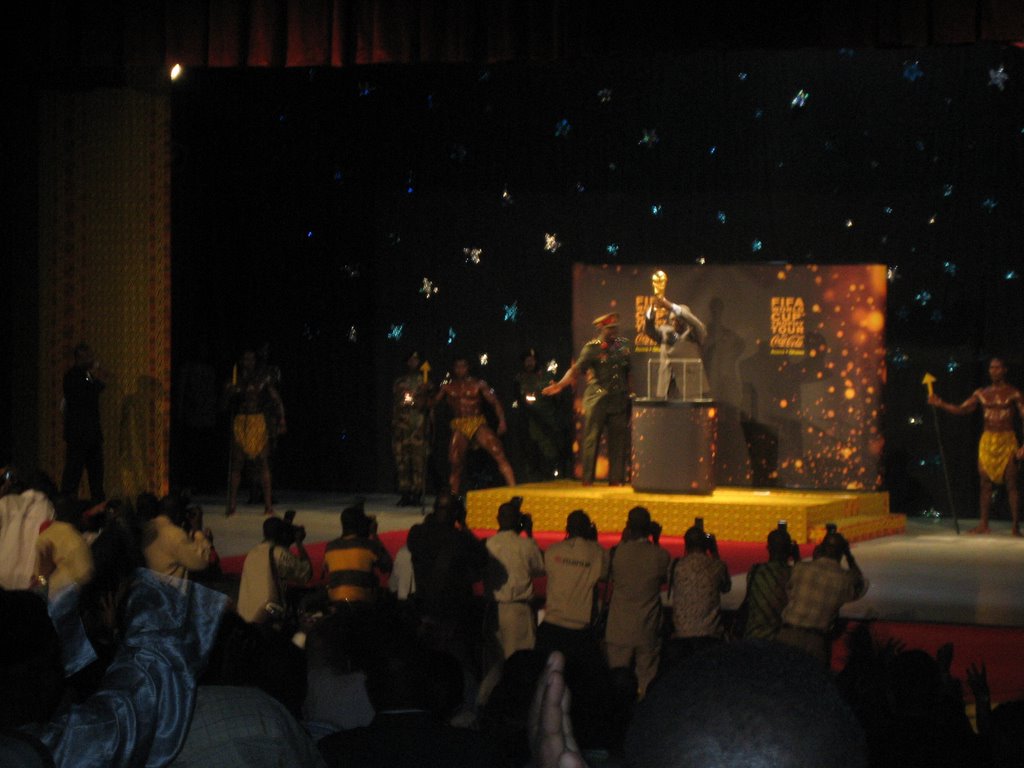
the picture is a bit hard to see, but it is of prez. kufour raising the trpphy aboce his head in accra during the trophy tour. i'm not complaining about the ceremony per se, because i was there, and certainly wanted to see the cup, but it raised a few questions for me.
the event was advertised as an opportunity to see the world cup and have your picture taken with it, so one would have thought it would be a one to two hour ceremony at MOST. i was very wrong, firstly it started 2 hours ( yes, 2 hours! ) late, for reasons i will leave you to guess. after that we were taken through a series of performances by the Black Stars supporters group and the Winneba Youth choir, a film on Ghana's football history, a special 3D film on the world cup and the trophy tour...and speeches by coca cola executives, the president, the list goes on...
by the time we finally got round to seeing the cup, we had been there 3.5 hours and counting.

i don't take issue with the ceremony, and how it was organized. not even really with the fact that it started late. did i mention the fact that apart from the president, practically every minister of state and deputy minister was there as well??? basically for at least 4 hours that morning, none of them did any of the work they're in office to do for the country. i mean seeing the trophy was nice, but was it worth that much? if it had been some sort of investors conference, or strategizing session...maybe an update on each person's vision for ghana in 2006, just something which might bring some benefit to the country somewhere along the line it wouldn't have been as bad. but a loss of that many hours of productivity ( multiply all the ministers, deputy ministers there by the number of hours) all to see the world cup trophy? that is a hard sell. granted i did see one minister leave before the ceremony was over, but that was it. and this on top of a holiday season in which for the previous 2.5 weeks every other day was a holiday ( or so it seemed) sure there is christmas, but then there is boxing day, and then another day because christmas fell on the weekend, and there's new year's, and another day because new year's fell on the weekend. and then who workd on the 24th anyway? and oh what's one more day at the end of the year?


i'm thinking we need to take another look at productivity, and the reasons for which we lose productivity. at a GDP per capita of under $400, maybe only the Minister of Education and Sports should have been there?

The Beauty of Competition :-)

a much overdue post on some observations i made in Accra

by the very first day i was inundated with adverts on the radio from all the cellular service providers
Scancom Ghana: areeba ( spacefon, then spacefon-areeba and now areebaa) : buy a sim card and get one free, plus the chance to be entered into a draw to win a mercedes, plus 2 free areeba t-shirts
Millicom Ghana :buzz : get buzz, because we're the only ones with buzz crbt ( caller ring back tone) and your friends can hear all these wonderful songs when they call you etc.
Ghana Telecom: one-touch: get one-touch ecause we have one-touch family and friends, where you can call your 4 (?) favourite people for 40% less.
Kasapa Telecom: kasapa: get kasapa because calls are free after 11pm and on weekends

some of the networks were advertising features that other networks already have or were also introducing, but each was trying to push theirs out as unique, and the best buy. i was amazed everytime i heard the ads. was i really in accra? 13 years ago, Millicom Ghana Ltd. pioneered Mobitel as the first cellular service provider, and that was followed by kasapa ( then celltel). 9 short years ago Scancom introduced areeba ( then spacefon) and quickly picked up a lot of customers since they had GSM whereas mobitel had pioneered an analog service. spacefon soon became the dominant service provider, and their sim cards and pre-paid units were extremely highly priced, but seeing as they had very little competition, they could afford to do that.

today the landscape is completely different. although areeba has the broadest coverage nationwide, and by far the largest subscriber base, one-touch and buzz now offer services to rival it, and are picking up quite a few cutomers with their more reasonably priced pre-paid units. also quite frankly, areeba used to be the network of choice also because it was considered 'cool'. not so anymore...buzz and one-touch have upped their 'coolness factor' and are competing hard.

kasapa is a different story. they are pioneering CDMA technology in ghana, and have managed to offer a fully connected handset for about 100,000 cedis ( a little over 10 dollars). in accra in december, there were quese daily outside the kasapa offices to get phones. there were police officers at the offices to control the crowds - it was that bad.

it has been really exciting to see how the competition has forced the different service providers to improve their performance, and find a basis to compete. they all sold sim cards for unreasonable prices in the beginning, but now all the rates have been slashed incredibly. who would have ever thought that you could get a 'starter pack' (sim card and a few units, with instructions etc.) for 20,000 cedis (a little over $2, buzz promotional rate in december)

granted, there is still some work to be done on the quality of service itself, particularly in relation to calls between areeba and one-touch. when i first to accra i thought my phone wasn't working, due to the number of times i got the message 'call not allowed!' but i realized later that was the usual process for making a call from an areeba user to a one-touch user. both companies claim they are not doing anything intentional, but the interconnection is terrible. this is while there is an ongoing feud between the two on interconnection rates (money paid by ghana telecom to scancom for calls originating on the one touch network and terminating on the areeba network and vice versa). one wonders whether it is really no fault of the providers. hopefully 2006 sees the National Communications authority mandating that something be done about this.

Tags: ghana, areeba, one-touch, kasapa

Thursday, December 15, 2005

Two New Investec Funds Target African Markets

http://clubgh.com/showart.asp?cat=8&art=1081

"FUND manager Investec Asset Management yesterday announced the launch of two funds investing in African markets, to tap further into the continent's vast
investment potential.... "

interesting development drawing attention to financial markets outside south africa. hopefully the interest in the huge potential for returns in some of the sub-sharan african markets leads to better access to capital for companies operating in these countries. IMHO access to cpaital has long been a problem, and is a key component in tackling the challenge of development through entrepreneurship. Unfortunately the returns haven't been very consistent, with the GSE (ghana) having a terrible run for the better part of this year.
In addition to this we need to get our governments (and people) to ensure better governance, so investors ( both from within and outseide the country) have better security. Then that'll pave the way for more interesting investments, like the expansion of PE firms outside of south africa, and access to venture funsing on a larger scale.

Tags: Investec, africa, finance africa

MyJoyOnline.com, Top stories - Ghanaian graduates develop software to ease health care delivery

http://www.accra-mail.com/mailnews.asp?id=15007


"ChildNet Electronic Publishing, Ghana's first local educational software
developer and producer will be launching its first product, Squirrel's
Compututor. ChildNet Electronic Publishing was formed in 2003 by four University
and Polytechnic graduates to develop their own range of software for children."

some pretty exciting news in my opinion, i haven't actually seen the product yet, but there's something to be said for the fact that new graduates are actually going into that area, and the public interest is great as well. It gives me hope that perhaps even a few more people are seeing that there is only so far that we can go if our fortunes are permanently tied to cocoa production, and subject to the vagaries of the world market. On a personal note though, I think education is *incredibly* important, and that technology can be an incredible force in improving access and quality, so i look forward to following this project. There'll be afollow up post when I have more information, and hopefully have demo'd the software. That's one of the drawbacks...none of the stories say very much about exactly what the software does, whether it is being used anywhere, the target audience, business model etc. I guess we have to start somwehere though, no?

Tags: ghana, e-learning, ChildNet

Wednesday, December 14, 2005

BBC NEWS | Africa | Microsoft Swahili speakers launch

BBC NEWS | Africa | Microsoft Swahili speakers launch

"The company argues that in a region with few computer users and high illiteracy rates, the Swahili version of Windows will inspire East African governments to expand their IT economies, encourage literacy campaigns and attract more computer users."

encourage maybe, but isn't there still the high cost barrier?


Monday, December 05, 2005

TECTONIC: Jonga search engine launches

"Alistair Carruthers launched South Africa's biggest Web search engine, Jonga, today. The one-man project took two years to complete and features a creative mix of open source and proprietary technology."

More below:

TECTONIC: Jonga search engine launches

Saturday, December 03, 2005

US Visa Lottery Drains Ghana

General News of Monday, 21 November 2005

A comparison of a few countries' populations
Ethiopia: 73 million
Nigeria: 129 million
Bangladesh: 144 million

and Ghana? population: 21 million. What do the countries above have in common? Those are just a few of the countries which (according to an article in Ghana's Daily Graphic) Ghana has surpassed in the number of profesionals leaving the country each year. Yes, the number of professionals, not the percentage of the population leaving. It is estimated that an average of 8,000 Ghanaians leave the country annually through the US diversity lottery. That is to say nothing of the people who leave and go to other countries, people who work in both the US and other countries illegally, and the students who leave to go to university and do not return. Whichever way you look at it, Ghana has a significant problem with the 'brain drain'.

Doctors and nurses emigrate at an alarming rate, making the health sector one of the most hard hit, but according to the article, accountants, engineers, lawyers and pharmacists are also among the people leaving in large numbers. Why are they leaving and where are they going? It is estimated that about 47% of Ghanaian college graduates live outside the country. This statistic is scary.

In my view, this can be looked at in several ways. First, on just the most basic level, who is left working in the country? The director of the Ghana Health Service, Dr. Akosa estimates that he has 'at least 9 hospitals which have no doctors at all.' This is to say nothing of the many other hospitals which are woefully understaffed. In Korle-Bu, the nation's 'premier' teaching hospital, many of the doctors still making the rounds on the wards taught people who in many other places would be close to retirement. Yes, their students would be close to retirement, to say nothing of them. The brain drain in the health sector puts an incredible strain on the remaining health workers, and the sector in general. A case in point is when the recent death of 3 Ghanaian urologists in a road accident cost the country 43% of its urologists. Yes, for a country with a population of over 21 millon, there were 7 urologists. How many Ghanaian urologists have been trained in even the past 20 years? The situation with nurses is no bettter. A 2003 report estimates that Ghana had about 10,000 nurses at the time, for a population of over 21 million, when nurses training colleges turn out over 600 nurses a year.

University lecturers, civil servants, technical professionals...different profession, same story. The Tema oil refinery recently closed its catalytic cracking plant shortly after the media had been full of stories of technical professionals from the plant leaving for more lucrative jobs in other countries.

The situation is admittedly bad, but why do they leave. That's not a hard question to answer. One just needs to compare the average salary of a nurse, doctor, univerity lecturer etc. in Ghana with one in a developed country, and the answer is clear. And it is not even a question of greed or wanting to maximize their earnings( for a lot of people), but a need to survive. It is easy enough from afar to talk about the need to sacrifice for the good of one's country, and give back etc. but when feeding your family from one day to the next, and paying your kids' school fees become aproblem, it is no wonder that sacrificing for your country slips down the priority list.

The more interesting question perhaps is what can be done? Many interesting suggestions have been promulgated, and several implementations of sorts have taken place. A lot of people place the burden of action on the developed countries, especially in the health sector, and there have been calls for a total ban on the employment of nurses ( read poaching) from certain countries. In Ghana for instance, it is currently very difficult for trained nurses to get visas to go to 1st world countries. Some people have talked about foreign countries paying governemnts directly for the professionals working in their countries, but that would be a messy undertaking by any estimation, and at any rate, is the money really what we need? Yet others say the emigration of Ghanain professionals is not as bad as it is made out to be, afterall, remittances from Ghanains living abroad are one of the single largest contributors to GDP of the country. Unfortunately, I don't think the remittances translate directly to a replacement of the skills lost with those who leave.

In a nutshell trained professionals are leaving largely because they can't make the money commensurate with teir skills in Ghana, and often have deplorable living conditions. A simplistic solution many people put out is to pay them better. That's easy enough to say, but where does the money come from? On some level, the government could probably cut spending in other areas ( read: how many ministers does a country of 21 million really need??), but that is not an entire answer. I would argue that the promotion of private enterprise would lead to wealth creation, and increased government revenue in terms of tax revenue and general consumer spending, and that could translate to more money to put into esssential services like education and healthcare. Ghana's 'golden age of business' is a step in the right direction, but with stories i've heard from people about the continued difficulty of sourcing capital and setting up a business, it seems more like a 'gold plated' ( and not reallly golden) age of business...

Another solution would be encouraging college graduates from Ghana ( and other African countries to return home). Of course there need to be increased opportunities for them, but to a large extent people need to be willing to go back for these opportunities to be expanded.

This has become a rather lengthy posting, but I think it is an important issue, and hopefully i practice what i preach :-)

File under: ghana, brain drain, diversity visa lottery

Friday, November 11, 2005

Ghana's 2006 budget encourages Venture Capital Funds

Business News of Thursday, 10 November 2005

The private sector is talked about a lot as one of the highest potential drivers of growth for the economy, but acess to capital is usually an obstacle in promoting private enterprise. Baah'Wiredu's 2006 budget gives previously unheard of incentive to people interested in launching VC funds, so hopefully this should spur some innovation and private enterprise. One of the highlights is tax deductions for financial institutions who invest in VC subsidiaries (100% of their investment), and the Ghanaweb article also says:
"The incentives are the upfront relief from stamp duty in each year on subscriptions for new equity shares in venture capital funds, the full tax exemption from corporate income tax, dividend tax and capital gains tax for five years and the provision for the losses from disposal of the shares during the tax exempt period to be carried forward to the post-exempt period up to five years."
It is great that the government is not putting itself in the middle of this, and is encouraging the private sector to take it up. It does however raise a question someone brought up in a conversation we had. The issue of regulation. The tax breaks are pretty substantial, and we could see a slew of people setting up VC funds to finance (in my friend's words) 'their sister's rice importing business.'

File under: ghana, vc, baah-wiredu


Thursday, November 10, 2005

Togo: the (largely) untold story

People around the world were quick to decry Faure Gnassingbe being put in power by the Togolese army after the death of his father, Gnassingbe Eyadema. This led to elections marred by violence, and after that little has been heard about the situation in Togo. In September, the UN released a report stating that almost 500 people were killed in violence surrounding the elections, but the report has received little attention, and the plight of the Togolese people goes largely unnoticed.

Togo comes to mind after a talk I went to on Tuesday, where a Togolese human rights journalist spoke about the situation, and showed pictures of the post-election brutality. The pictures were horrifying, to say the least, and gave a perspective of the story we don't hear much. The journalist was in the US talking to groups of people and trying to rally people to put pressure on governments to put pressure on Faure and Togo to aloow for a more pluralistic democracy in Togo. He argues that while there may have been elections, they were far from fair, and opposiiton supporters are still being persecuted in Togo. The journalist himself is currently in exile in Ghana, after narrowly escaping in his words, an attempt on his life by the Togolese government.

The talk raised a lot of issues for me, the first just the most basic one of people being denied their fundamental human rights. The journalist showed multiple pictures of people who had been killed and beaten just for wearing opposition colours - horrific pictures. Can there be progress/development when people do not have the right to hold and assert particular points of view, when a perception of your opinion is enough to mark you for death?

Another issue was why he was in the states to begin with - something we talked about at length. I asked the journalist why he didn't talk to leaders in Africa, Kufuor, Obasanjo and those of other neighbouring countries, afterall, their pressure helped to force elections. He recounted how they have tried that to no avail; he was adamant about collusion between the regional governments, but I will not pursue that for now. What struck me most about this was the similarity between the current situation in Togo and what has previsouly happened in Ghana and many other places. The extra-judicial kidnappings and murders are reminiscent of stories from Ghana under a certain leader who shall remain nameless, and few African countries are strangers to elections where the incumbent military junta wins under what many people believe to be dubious circumstances. Why then would African leaders not go to the aid of people fighting many of the same battles they fought? Is there something to his claims of collusion, or are each countries problems just too large and numerous to warrant attention to any others?

This is an issue I've been thinking about for a while, particularly in relation to the idea of an African identity( a topic i will leave for a future posting). Are we largely blind to the problems of neighbouring African countries because we see them as having no bearing on us? This issue came to the forefront again when I was listening to a Ghanaian radio programme online. The host was commenting on a news story about violent protests by a rgoup of refugees in Ghana. He and his co-host made uncomplimentary comments about the refugees, and how they should be sent back to their countries,since Ghana has its own problems. Admittedly Ghana has many problems, and unrest caused by refugees is certainly not something to turn a blind eye to, but surely such comments go against any semblance of commiseration and attempts to provide support to fellow Africans.

I digress, but my point was to look at why to a large extent, Africans are unwilling to help each other. I could understand the (Togolese) journalist when he calimed to have lost faith in international institutions, but when he made the same statements about other African countries, particularly the governments, that hit me hard. He was largely convinced that none of them cared about the plight of the Togolese people.

Later in the day I saw emails which had been sent to him from other Togolese in exile in Ghana. My heart tore as I read stories of their misery, strangers in a foreign land, dying to go home, but having to make a choice between a familiar environment and comfort, and their lives. It was as simple as that.

I'm the first to admit that Africa has many problems, perhaps some arguably more threatening than human rights abuses in Togo, but this shouldn't fall between the cracks. When people do not have the right to express themselves freely without fear for their lives, there is a problem. A similar situation is brewing in Ethiopia, with the government of Meles Zenawi victimizing protestors.
Is this a cycle we will never break?


Wednesday, November 09, 2005

BBC NEWS | UK | Education | Illiteracy 'hinders world's poor'

BBC NEWS | UK | Education | Illiteracy 'hinders world's poor'

BBC carries this story on the link between illiteracy and poverty. It's another point in favour of focusing on literacy as a driver of development. I would agree that literacy is important, but to play the devil's advocate here, the article fails to make a strong case for the link between redusing illiteracy and increasing people's economic wellbeing. Sure, it shows that there is a link between poverty and illiteracy, with the poorest regions of the world having the lrgest percentagees of illiterate people, but stops there. As a former professor of mine would say 'correlation does not imply causality'

File under: education, literacy